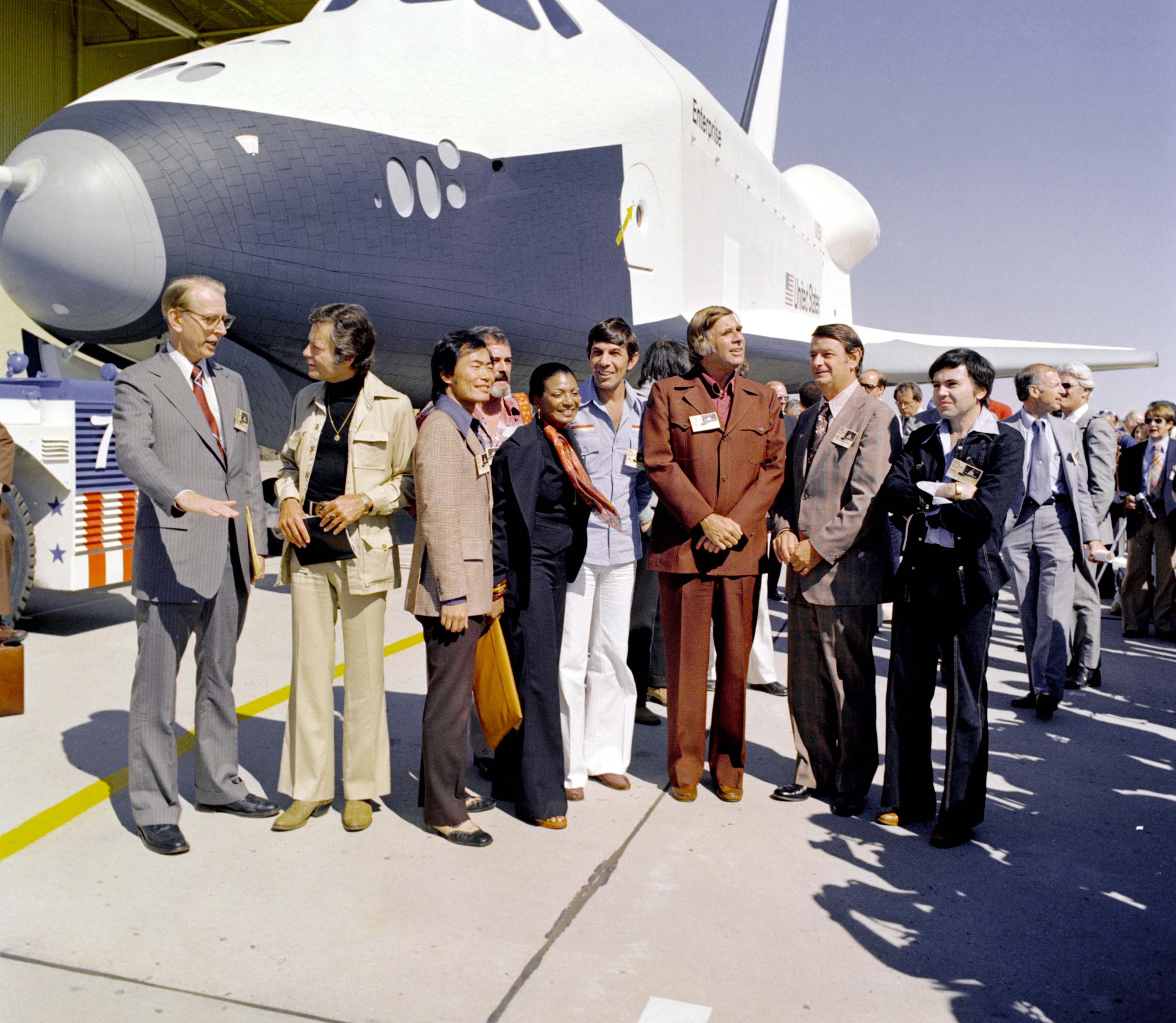
The photograph has the cheerful impossibility of two futures meeting. Star Trek’s cast and creator stand in ordinary clothes before a full-size spacecraft, its nose rising above them. The scene is real: Enterprise’s public rollout at Palmdale on September 17, 1976. NASA marked its fiftieth anniversary this week by returning to that image. The fictional ship had helped name the real one; the real vehicle’s most important journeys would take place inside Earth’s atmosphere.[1]
That is the productive tension in Enterprise’s history. A rollout makes a machine look complete. A test program exists because much remains to be learned. The public sees a recognizable object with a name and a promise. Engineers need answers to smaller, harder questions. How does it behave in a particular configuration? Can the crew control it? Which part of a larger mission has actually been demonstrated? The difference between those views is where a prototype earns its place.
A name borrowed from an imagined future
The orbiter was originally to be called Constitution, with its unveiling aligned to Constitution Day in the bicentennial year. A campaign by Star Trek fans helped change the name. NASA Administrator James Fletcher, Gene Roddenberry and several cast members attended the ceremony: a public inspired by fiction had become involved in naming a national engineering project.[1]
NASA historian John Uri’s account fills in the industrial sequence. Construction began in 1974, with components produced and assembled over the following two years. The original concept contemplated converting the atmospheric test vehicle into an orbiter capable of spaceflight, but the modification proved too expensive. Enterprise instead continued as a test article. That history makes the eventual outcome more interesting than a simple story of a spacecraft that failed to reach its destination: its assignment changed as the program learned what conversion would require.[2]
The carrier aircraft was part of the experiment
Before independent flight came work with a modified Boeing 747. A NASA photograph dated July 26, 1977, records the test crews in front of the paired aircraft after the final captive-carry flight. The carrier made it possible to put a full-size orbiter into an approach-and-landing test without first launching it into space. The subsequent five free flights addressed a precise capability: bringing the vehicle to an unpowered runway landing.[3]
There is an economy to that arrangement. A full orbital flight would combine ascent, on-orbit operation, reentry and landing in one mission. Separating the final phase made it possible to learn about that phase earlier. It did not make the rest of the mission unnecessary, nor did a successful landing demonstrate every condition an orbital vehicle would encounter. The value lay in asking a bounded question of hardware large enough to give a meaningful answer.[3]
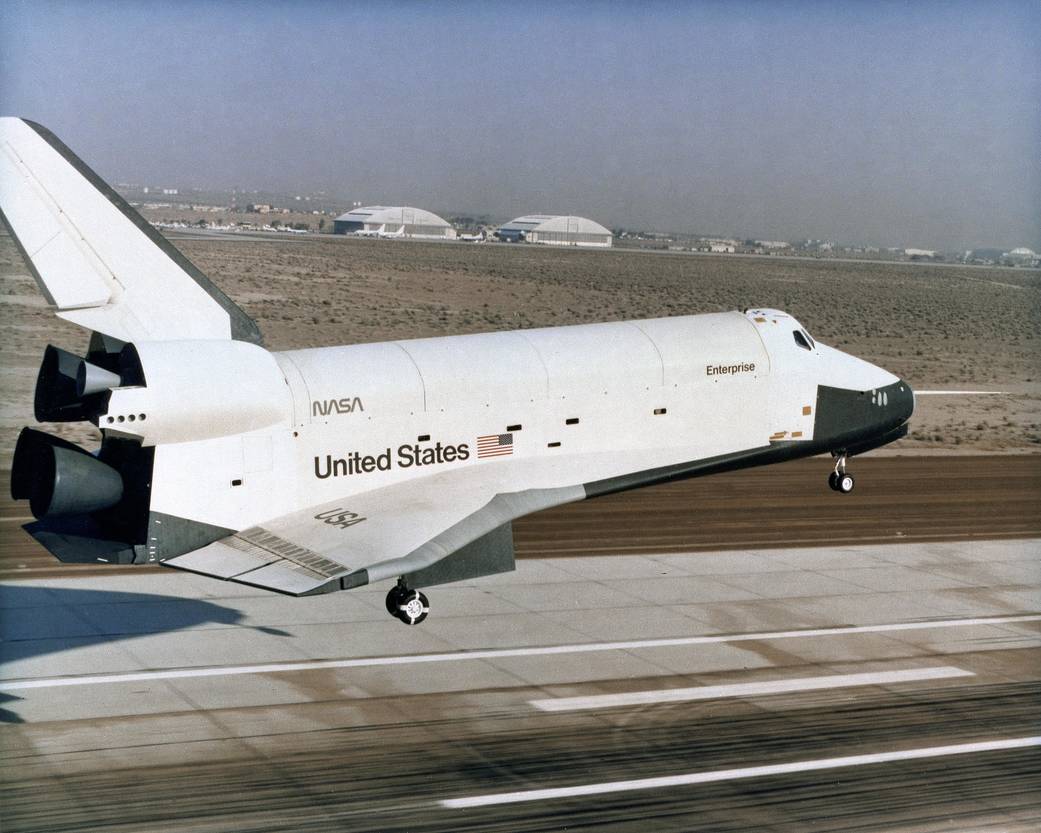
Image details
Original photograph; no generative alteration. Cropped in front-page previews; full proportions in article.
The sequence reached its last flight on October 26, 1977. NASA’s image record identifies Fred Haise and Gordon Fullerton as the crew for the final descent to Edwards Air Force Base’s main concrete runway. In the photograph, the landing gear is down and the vehicle is close to the surface. The image has none of a rocket launch’s flame or vertical drama. Its importance is the controlled arrival of an unfamiliar flying machine at an ordinary-looking strip of pavement.[4]
The contrast with the rollout picture is revealing. In one, people gather around the vehicle to see what it represents. In the other, the vehicle must do something specific while the available height disappears. The first photograph preserves public expectation. The second preserves a test. Both are part of the history, but they answer different questions about how a new machine becomes believable.
A prototype’s career continues after the headline
Enterprise’s work did not end with those landings. Uri’s history describes further tests for the orbiters that would fly in space, including fit checks at Kennedy’s Launch Pad 39A in 1979. Such work is easy to lose in a narrative built around firsts. A full-size article can expose awkward interfaces and practical incompatibilities that a drawing or an isolated component cannot. Its usefulness may outlast the original test campaign because the rest of the system continues to take shape.[2]
The fiftieth anniversary is therefore an opportunity to look past the appealing name without discarding it. Enterprise connected an imagined future to a material object, then helped turn selected parts of that future into evidence. The lesson is not that prototypes should look impressive or that an early demonstration settles every question. It is that a machine can have a consequential career by making the next decision better informed. For this shuttle, the voyage that mattered was not measured in orbits.
Sources & further reading
Original reporting and research behind this article.
- NASA: Enterprise rollout at fiftySep 17, 2026
- NASA history: Enterprise’s public debut and test careerSep 17, 2021
- NASA: crews after the final captive-carry flightReferenced Sep 19, 2026
- NASA: October 26, 1977 final flight photographReferenced Sep 19, 2026