A new Smithsonian American Art Museum exhibition opens Friday, September 18, bringing together 225 photographs by more than seventy photographers. “Much Here Is Beautiful: Photography Surveys of the U.S. Bicentennial” runs through April 18, 2027. Announced Tuesday, it revisits work supported by a National Endowment for the Arts program that funded 72 surveys in the late 1970s and early 1980s.[1]
Its geography includes Martin Stupich’s photographs of Atlanta’s MARTA construction and Robert Townsend Jones Jr.’s work on Memphis’s Beale Street. A western section includes the Rephotographic Survey Project, which returned to sites associated with nineteenth-century photographs. These are several different ways to record a country: follow new infrastructure, attend to a neighborhood, or make change visible by repeating an earlier view.[1]
That range is the exhibition’s most interesting premise. A national anniversary invites a single emblematic image. A survey can instead gather many partial views whose differences become the point. The construction site, streetscape and revisited landscape place the emphasis on an America being used and altered, with a future that the photographer cannot fully know.
A photograph acquires new questions
The purpose of a documentary picture can change while its visible contents remain the same. At first, a building may be evidence of a project under way. Decades later, the same frame may preserve a sign, a storefront or the relationship between a road and the homes beside it. What seemed incidental can become the detail a later viewer most needs.
An earlier federal project offers useful context. The Library of Congress’s FSA/OWI collection records American life between 1935 and 1944. Roy Stryker directed much of the effort as it moved through the Resettlement Administration, Farm Security Administration and Office of War Information. The collection also contains material acquired from other public and private sources, making its institutional history part of understanding the pictures.[2]
The comparison does not make the two programs equivalent. It suggests a common reading practice: ask who commissioned the work, which places and people were selected, and what survives outside the chosen print. Documentary authority grows stronger when those decisions are visible. A large archive is still a collection made through choices.
The roadside as an archive
John Margolies’s separate Roadside America archive, held by the Library of Congress, contains 11,710 color slides made from 1969 to 2008. His subjects include motels, restaurants, theaters and other commercial structures. The library describes his preference for clear morning light and unobstructed views, choices that help explain the distinctive clarity of the resulting record.[3]
His 1993 photograph of the Townley milk bottle in Oklahoma City, reproduced here as historical context, shows a giant advertising bottle above a small brick building. The catalog identifies the location at 24th and Classen Streets and credits Margolies. It is a separate Library of Congress example, not an installation photograph or a claim about which prints appear in the Smithsonian exhibition.[4]
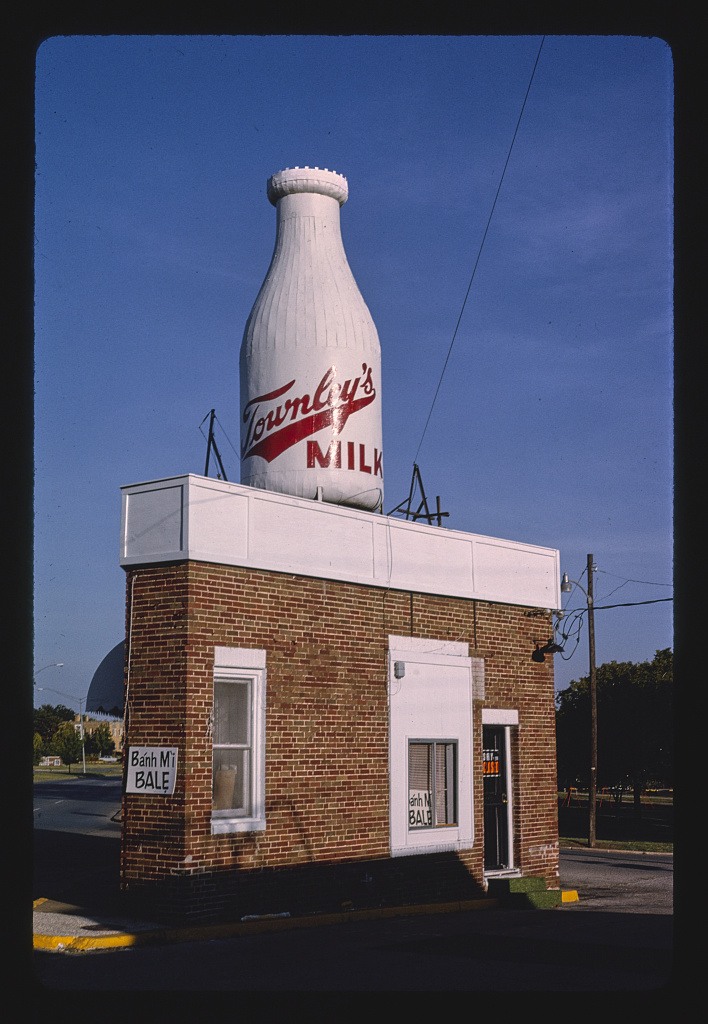
Image details
Resized proportionally and encoded as JPEG; no retouching.
In the frame, the oversized bottle competes with a much smaller storefront and its signs. The scale makes the commercial purpose legible at a distance, while the photograph preserves details that a passing motorist might miss. The ordinary building and extraordinary advertisement coexist in one practical piece of streetscape.
The Library of Congress purchased the intellectual-property rights to Margolies’s photographs with the archive and reports no known copyright restrictions on the images. Its digitized holdings let readers inspect this kind of record without relying solely on a museum’s selection. Dates, captions and neighboring images can help turn a memorable picture into a more specific historical question.[5]
A worthwhile way to approach the Smithsonian show is to look for what each survey makes comparable. Repeated viewpoints can expose physical change; repeated attention to a type of place can reveal variation. The individual photograph supplies the detail. The series supplies the relationship that lets the detail mean more.
Sources & further reading
Original reporting and research behind this article.
- Smithsonian: Bicentennial photographic surveys exhibition announcementSep 15, 2026
- Library of Congress: FSA/OWI photograph collectionReferenced Sep 17, 2026
- Library of Congress: Roadside America archive guideJul 25, 2025
- Library of Congress: Townley milk bottle catalog recordReferenced Sep 17, 2026
- Library of Congress: Margolies reuse rights and archive contextJul 6, 2017