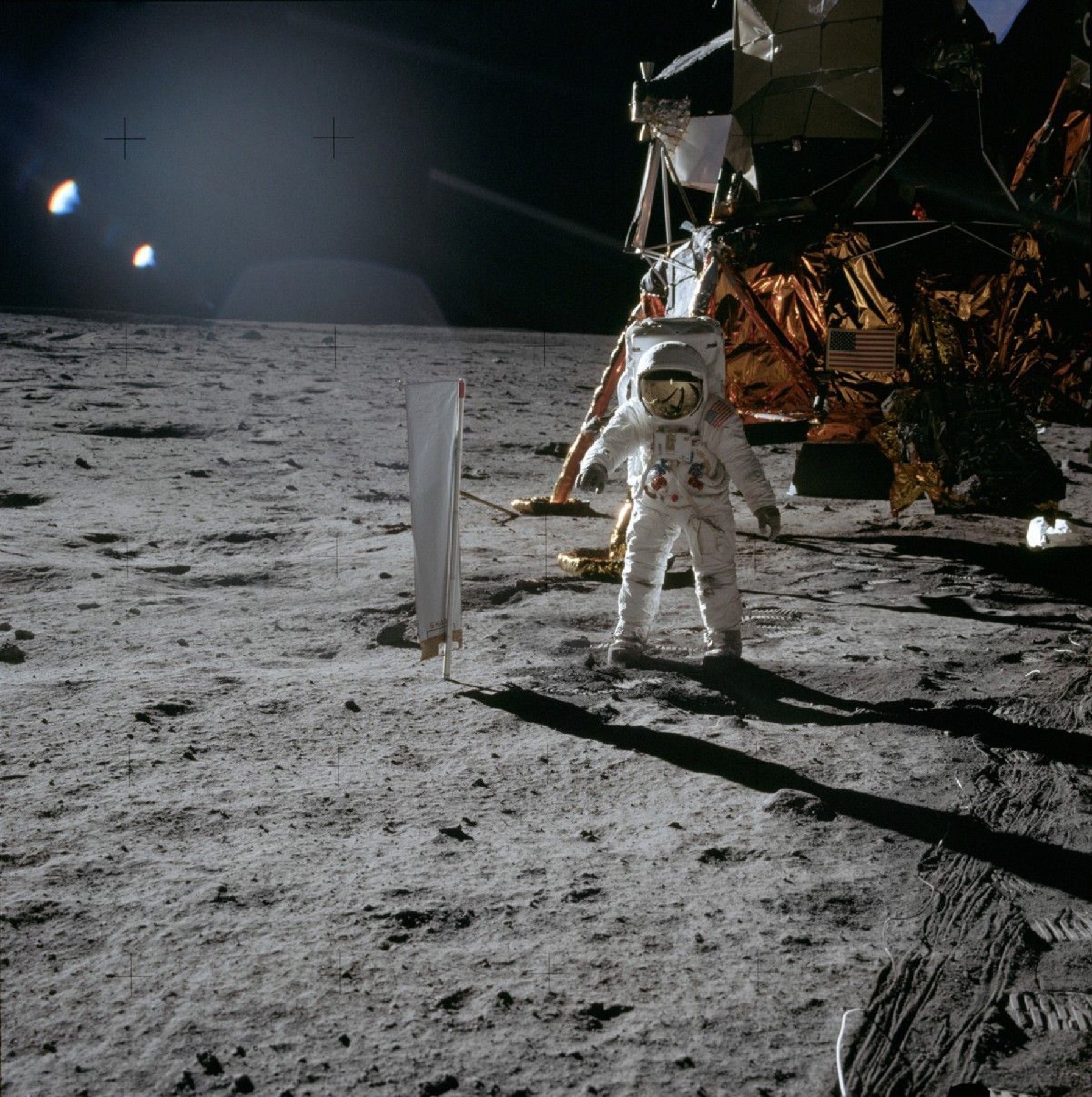
Beside Buzz Aldrin in an Apollo 11 photograph stands an object that looks almost implausibly modest for a lunar experiment: a narrow sheet mounted upright on a pole. The lunar module dominates the background. The foil occupies little of the frame. Yet it was there to collect something the rocks under Aldrin’s boots could not provide in the same controlled way—a sample of particles arriving from the Sun.[1]
The University of Bern’s Solar Wind Composition experiment trapped particles in specially prepared aluminum foil, which the astronauts returned to Earth for laboratory analysis. Versions flew on Apollo 11, 12, 14, 15 and 16. Its essential division of labor was elegant: use the lunar visit to expose a collector, then use terrestrial laboratories to ask what had become embedded in it.[2]
That choice relocated much of the instrument. The visible hardware did not need to perform every measurement on the surface, because the mission could bring the material back. The experiment’s reach therefore extended beyond the equipment that traveled to the Moon. It included the techniques, cleanliness and judgment available after return—and, if material could be preserved, techniques that would become available later.
A surface with a memory
A 1972 report on the Apollo experiments describes the foils as targets for implanted solar-wind ions and presents preliminary helium and neon results. The objective was elemental and isotopic composition: identifying what was present and comparing forms of the same element. A collector was useful because exposure left a physical record that could be examined after the flight had ended.[3]
The distinction between collecting and measuring is important. A returned surface is not a finished answer. Researchers still have to establish what belonged to the original material, what arrived during the intended exposure and what may have been added during handling. The apparent simplicity of the collector transfers difficulty into preparation and interpretation. A small piece of hardware can support a sophisticated experiment precisely because the laboratory is doing work that the hardware does not.
Bern later used the foil-collection approach in COLLISA, an experiment carried on the Mir space station’s Spektr module to study interstellar particles. Exposed material returned to the university’s laboratory. The technique was therefore not confined to one iconic moonwalk; it became a way to obtain physical samples from environments in which directly carrying a full analytical laboratory would be a different proposition.[2]
The collector also defines a window in time. Whatever a laboratory later learns from it must still be interpreted as material gathered during that exposure and under those conditions. Better instruments can extract more information from an old sample, but they cannot retroactively make its collection represent every environment or every moment. Preserving context is as necessary as preserving matter.
Genesis makes the collector a spacecraft
NASA’s Genesis mission launched in August 2001 to collect solar wind and return it to Earth. It sampled near the Sun–Earth L1 region and sent its return capsule home in September 2004. The mission extended the sample-return idea beyond the lunar surface: a dedicated spacecraft could spend far longer gathering material than an astronaut’s surface excursion allowed.[4]
The Genesis sample catalog describes 28 months of collection and solar atoms typically implanted only 40 to 100 nanometers below polished collector surfaces. Its entries include images, collector material, dimensions, exposed area, solar-wind regime and a qualitative assessment of surface condition. Those fields are not administrative decoration. They preserve distinctions that determine what a particular fragment can help a scientist investigate.[5]
The collectors used several exceptionally pure materials, including silicon, sapphire and coatings containing gold or diamond-like carbon. A September 2004 description explains the competing requirements: survive launch, retain implanted elements while heated by sunlight and remain clean enough for those elements to be distinguished during analysis. Different materials retained different elements, so a collection built from more than one material offered different analytical opportunities.[6]
The same account describes using thin collecting layers on supporting substrates to reduce the contribution from impurities in the collector itself. The engineering problem was inseparable from the scientific one. Making the spacecraft survive was necessary, but so was making the returned material interpretable at a scale far smaller than anything visible in a launch photograph.[6]
This is a useful way to understand why sample-return missions cannot be judged only by the amount of material they bring back. The value depends on what the sample represents, how securely its origin is known and whether its condition permits the intended measurement. More material with poorly understood contamination can answer fewer questions than a small, well-characterized specimen. Quantity is one input to the scientific opportunity, rather than a complete measure of it.
A 2023 study of Genesis collectors adds another complication: collecting particles can change the collector. The researchers found changes in optical properties, surface chemistry and material structure associated with solar-wind exposure. Their results were preliminary, but the experiment offered a controlled way to examine early space-weathering effects on several materials exposed to different wind regimes.[9]
The collecting surface thus becomes evidence in two directions. Implanted atoms carry information about the incoming material, while changes in the substrate can help reveal what that exposure does to a surface. Those uses need careful separation. A property that complicates one measurement may itself become the subject of another investigation, provided the exposure and material history remain sufficiently well documented.
A failed landing, an unfinished experiment
Genesis’s return capsule struck the Utah desert on September 8, 2004, after its parachutes failed to open. Two days later, the recovery account was cautiously hopeful. Many collector wafers appeared broken, but sizeable fragments could be recovered. Investigators reported intact gold foil and surviving concentrator material. These were early assessments, not a declaration that every original science goal had already been secured.[7]
That contemporary report matters because it records the uncertainty at the point of recovery. Some material had been exposed to the desert environment; breakage and contamination changed the work awaiting the laboratories. The mission did not acquire a clean outcome simply because useful samples survived. Recovery became a new phase of the experiment, with its own questions about which pieces remained suitable for which measurements.[7]
There are two tempting ways to flatten that history. One is to treat a hard landing as the end of all scientific value. The other is to treat later research as proof that the failure had no consequence. Neither respects the work between those moments. A damaged collection can retain substantial value while becoming much more difficult to use. Salvage is an achievement in its own right, not evidence that the original loss was imaginary.
The mission’s retrospective records subsequent scientific use, including a 2011 finding about differences between solar and terrestrial material relevant to the early solar system. That later evidence supplies what the immediate recovery statements could not: proof that a failed return sequence did not prevent all meaningful analysis. It does not make the first assessment less uncertain; it shows how research gradually resolved part of that uncertainty.[4]
The public photograph of a landing or a crater is often easier to interpret than the status of a scientific program. Physical damage is visible. The survival of an isotopic measurement is not. This makes the laboratory record especially important: it can explain how apparently ruined material remains informative, and where the limits of that recovery still lie.
The mission after the mission
In its May 2026 newsletter, the Genesis curation team described preparing previously approved samples for researchers while placing the collection into preservation mode. Requests submitted in September 2025 had been reviewed in April. The account said new requests would not be accepted during preservation mode, while leaving open the possibility of future allocation windows.[8]
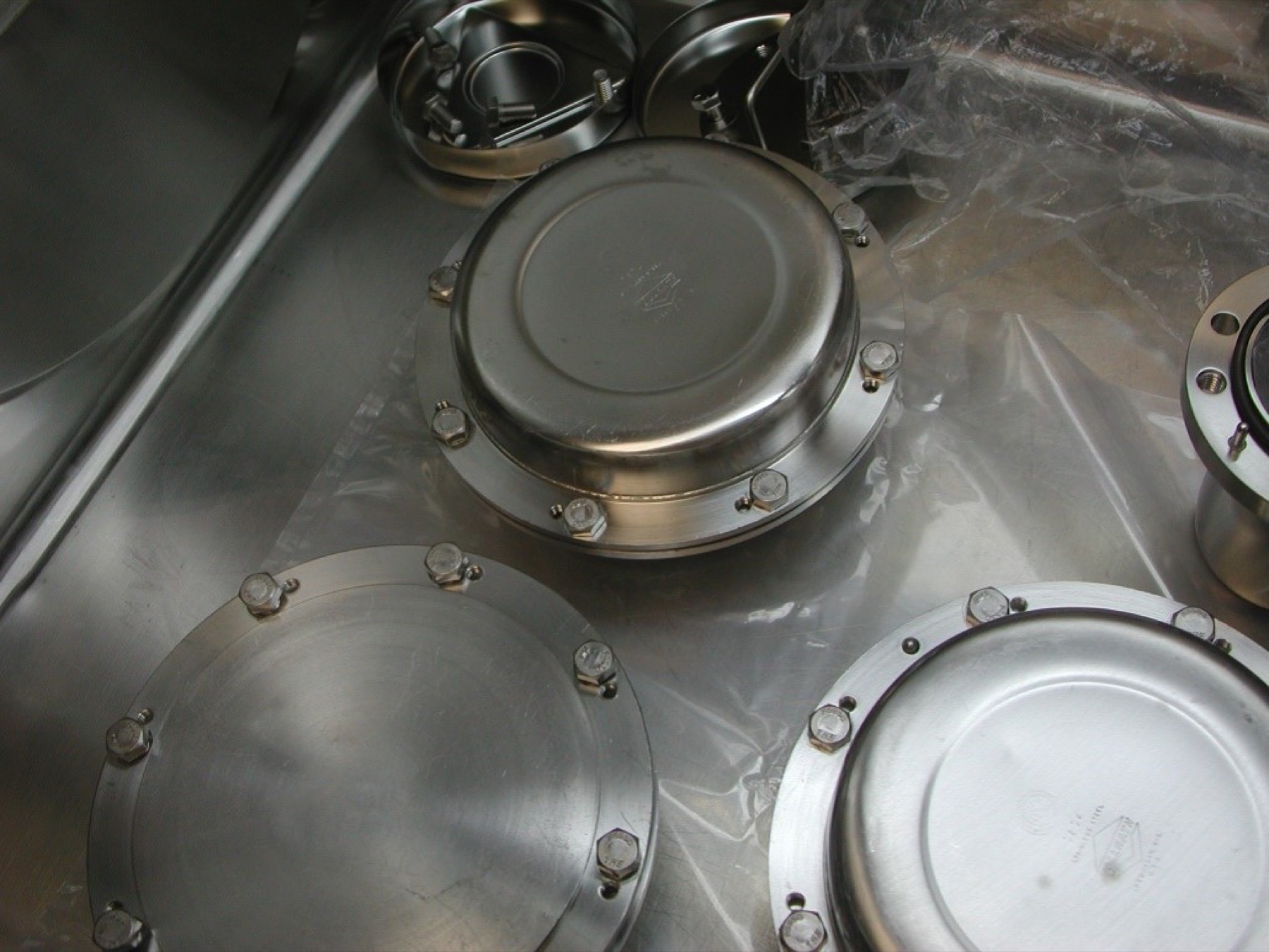
Image details
Resized proportionally; no retouching. Display crops disclosed by the reader.
The same update described transferring representative material to secondary storage and keeping samples in nitrogen-flushed stainless-steel cabinets with low oxygen and water levels. It reported a target of 15 percent representative storage at a second location. These are efforts to protect the remaining collection, not new sampling by a spacecraft. Genesis is still yielding a scientific future from material gathered more than two decades ago.[8]
Preservation changes the meaning of a successful mission. A sample that arrives on Earth is an opportunity with an uncertain lifespan. Every decision about storage, allocation, cleaning and documentation can enlarge or narrow the questions that remain available. The people doing this work may never stand beside a launch vehicle, yet they help determine how much science the launch eventually produces.
There is also a real allocation problem. A researcher wants access to material now; a curator must consider the value of leaving some material for methods and questions that do not yet exist. Neither objective is automatically superior. Immediate work can establish important results and improve techniques, while excessive consumption can reduce future options. The collection has to serve inquiry across time, not simply maximize the number of present-day transfers.
The catalog’s attention to fragment condition, material and collection regime makes that choice more informed. A specimen is not interchangeable with another just because both came from Genesis. Its documented properties help connect a request to an appropriate sample and give later readers a way to understand what was actually analyzed.[5]
The story that began with a sheet of foil therefore ends, for now, with records and containers. That is not an anticlimax. The purpose of bringing matter home is to make further questions possible, including questions the original mission could not fully anticipate. The durable achievement is a sample whose origin and condition remain understandable enough that someone else can use it.
Return to Armstrong’s photograph and the foil looks different. Its smallness no longer suggests a minor experiment. It shows how much scientific apparatus can exist outside the frame: the prepared material before launch, the exposure record, the laboratory after return and the continuing care of the collection. A spacecraft can complete its flight in a moment. An experiment built around preserved matter can remain open for generations.
Sources & further reading
Original reporting and research behind this article.
- NASA/JSC: Aldrin beside the Apollo 11 solar-wind experimentJun 28, 2018
- University of Bern: Apollo and COLLISA collection experiments (reference date)Sep 13, 2026
- Geiss and colleagues: Solar-wind composition experimentJan 1, 1972
- JPL: Genesis mission retrospective (reference date)Sep 13, 2026
- NASA: Genesis sample catalog description (reference date)Sep 13, 2026
- JPL: Genesis collector materialsSep 3, 2004
- JPL: initial Genesis recovery assessmentSep 10, 2004
- NASA Astromaterials: Genesis curation updateMay 1, 2026
- Jurewicz and colleagues: space weathering of Genesis collectorsMay 30, 2023