A clock can tell an observer something about where it sits. General relativity predicts that clocks at different gravitational potentials run at different rates. As precision improves, that distinction becomes a measurement tool: a frequency comparison can reveal a difference that ordinary timekeeping was designed to ignore.[2]
In 2022, JILA researchers resolved a gravitational frequency shift across a cloud of ultracold strontium atoms separated vertically by about a millimeter. Rather than putting two independent clocks at different heights, they compared regions of a single sample. The effect was extraordinarily small, on the order of one part in ten to the nineteenth.[1]
The remarkable feature is not that the upper part of the sample received a different time signal from a control room. The comparison concerns the rate of the physical process used as the clock. At sufficient precision, where the atoms sit becomes part of the result. A property that ordinary clocks can ignore has become large enough to investigate.
A tiny effect with a measurable scale
NIST’s account of the 2010 optical-clock experiments gives a way to appreciate the scale. Near Earth’s surface, clocks separated vertically by a kilometer differ by only about three seconds over a million years. Those experiments compared clocks at height differences below a meter and relative speeds below ten meters per second. Relativistic effects were being brought out of the realm of fast spacecraft and large altitude changes into a laboratory-scale comparison.[2]
The later JILA experiment pushed the spatial comparison much further. An optical lattice held strontium atoms while researchers resolved the frequency shift across the sample. Its result agreed with the expected gravitational effect. The experiment opened possibilities for more sensitive investigations, but it did not resolve the relationship between quantum mechanics and gravity. That distinction separates the achievement from the larger questions motivating it.[1]
The physical idea is easier to understand if the clock is treated as an instrument with a rhythm rather than a display with hands. A display can be reset to agree with another display. A frequency comparison asks whether the underlying rhythms continue to agree. If two clocks initially show the same time but tick at slightly different rates, their readings will gradually separate. The useful signal can therefore be a ratio of frequencies rather than an accumulated difference on a clock face.
That also explains why a fractional discrepancy matters. The question is how large the change is relative to the rhythm being measured. A very small fraction can become detectable when the instrument is stable, its environment is understood and the comparison can be repeated long enough. The experiment does not require waiting a million years; that timescale is a way to express the size of the effect.
The apparatus around the atom
In July 2025, NIST reported an aluminum-ion clock with a systematic uncertainty of 5.5 parts in ten to the nineteenth. The aluminum ion supplies the clock transition, while a magnesium ion helps cool it and read out its state. The team redesigned the trap to reduce unwanted motion and improved the vacuum system. The result depended on controlling the surroundings as much as selecting a promising atom.[4]
A more stable laser also reduced the averaging time needed to reach the reported precision from roughly three weeks to a day and a half. NIST distinguishes systematic uncertainty from stability: one concerns how accurately the clock’s frequency is known, while the other affects how efficiently repeated measurements converge. The distinction matters whenever the instrument is expected to observe a changing world instead of a static laboratory condition.[4]
An analogy is a measuring instrument whose readings scatter around a value that may itself be biased. Taking more readings can reduce the uncertainty associated with random scatter. It does not automatically remove a shared offset. Conversely, an instrument with well-characterized offsets may still need a long series of measurements before a tiny change becomes clear. Clock research has to address both problems.
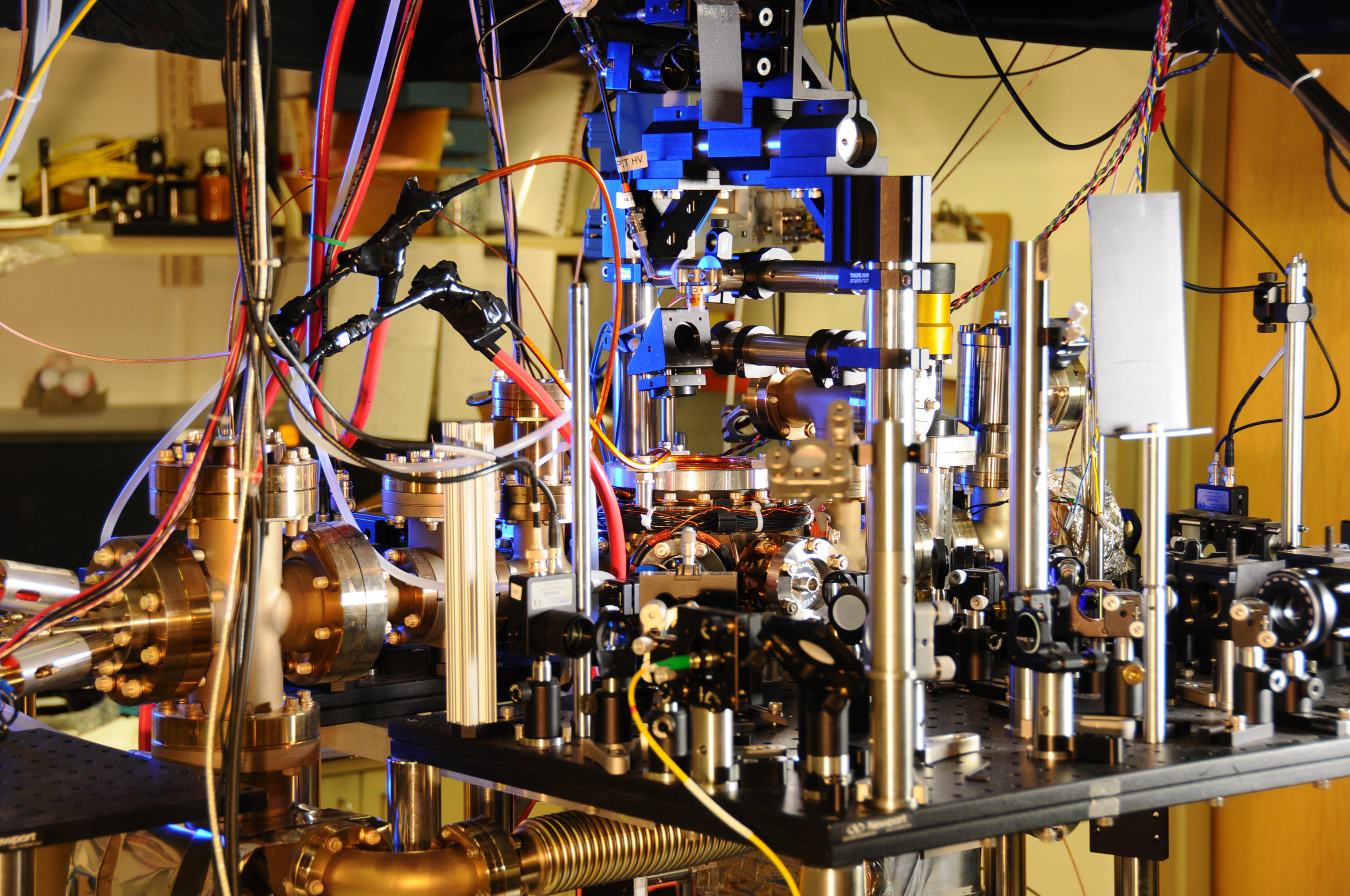
This is why photographs of atomic clocks are crowded with equipment. The atom is the reference, but the experiment needs ways to prepare it, interrogate it and isolate the influences that shift the result. The small trap pictured here belongs to a larger arrangement of lasers, electronics and controlled environments. Its size is not a measure of how simple the complete instrument has become.
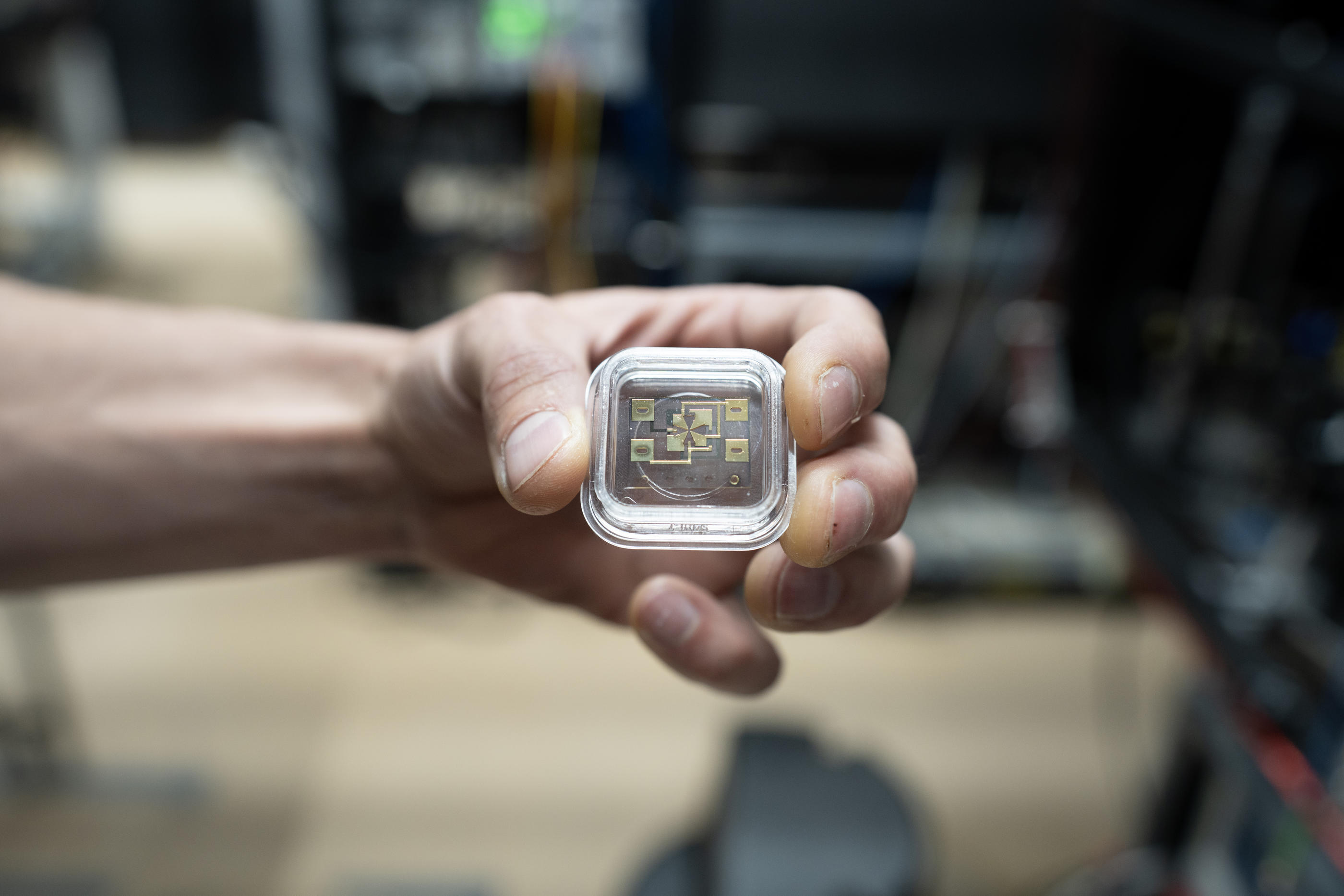
Image details
Source-supplied image. No retouching or generative changes by The Daybreak. Teasers may crop for layout.
A map of potential, not a pocket altimeter
A field experiment reported by Jacopo Grotti and colleagues in 2017 demonstrated the geographic step. They used a transportable strontium optical lattice clock to measure the gravitational-potential difference between a mountain location and another site about 90 kilometers away. Comparisons made both locally and remotely helped separate location-dependent effects from possible clock errors. Taking the instrument into the field was part of the measurement, not merely a delivery problem.[6]
The word potential is essential. A clock comparison does not directly produce the same quantity as a geometric height measurement. Converting its signal into a useful account of Earth requires a reference framework and other information. The attraction is that the clock supplies a different kind of evidence about the physical environment, which can complement existing measurements rather than simply replace them.
Imagine a future observing network that detects a change in the relative rate of two stable clocks. Before interpreting it as a change in the world, researchers would need to exclude changes in either instrument and in the link between them. If the change survives those checks, it still has to be connected to a physical explanation. The measurement provides a constraint; it does not independently identify every process responsible for it.
This distinction protects the promise of relativistic geodesy from being oversold. A sensor can be powerful without solving the full inverse problem—the task of working backward from an observed signal to its cause. Multiple observations, independent instruments and a model of the environment make that inference more useful. Better clocks expand the available evidence; they do not eliminate the need to interpret it.
The connection is part of the instrument
A 2025 review by Emily Caldwell, Theodora Triano and Laura Sinclair describes the techniques for transferring optical time and frequency through fiber and free space. The review distinguishes distributing time from comparing frequency and examines noise in the links. Its scope makes a practical point: an exceptionally capable clock is useful beyond its own laboratory only if its performance can be compared or communicated elsewhere.[5]
Think of two excellent measuring instruments joined by a poor communications channel. If the channel introduces a changing error larger than the effect being sought, the quality of the instruments cannot rescue the comparison. At the scale of optical timekeeping, the connection must be designed and characterized with the same care as the clock. A network is an experimental system, not simply a collection of outstanding endpoints.
NIST’s February 2026 account describes work to connect a portable clock on Colorado’s Mount Blue Sky with the Boulder area. The 2025 mountain visit focused on testing equipment and the connection. Because there was no direct line of sight to the NIST laboratory, the plan combined a fiber segment with a free-space laser link. The account described a developing experiment; it was not a publication of a completed new relativity test.[7]
The same report describes NIST’s ground equipment for the European Space Agency’s Atomic Clock Ensemble in Space, launched to the International Space Station in April 2025. A receiving system on the Boulder campus links ground-based clocks with the space experiment. The two-year observing plan and its intended precision are goals stated by the project, rather than results that should be assumed from the launch alone.[7]
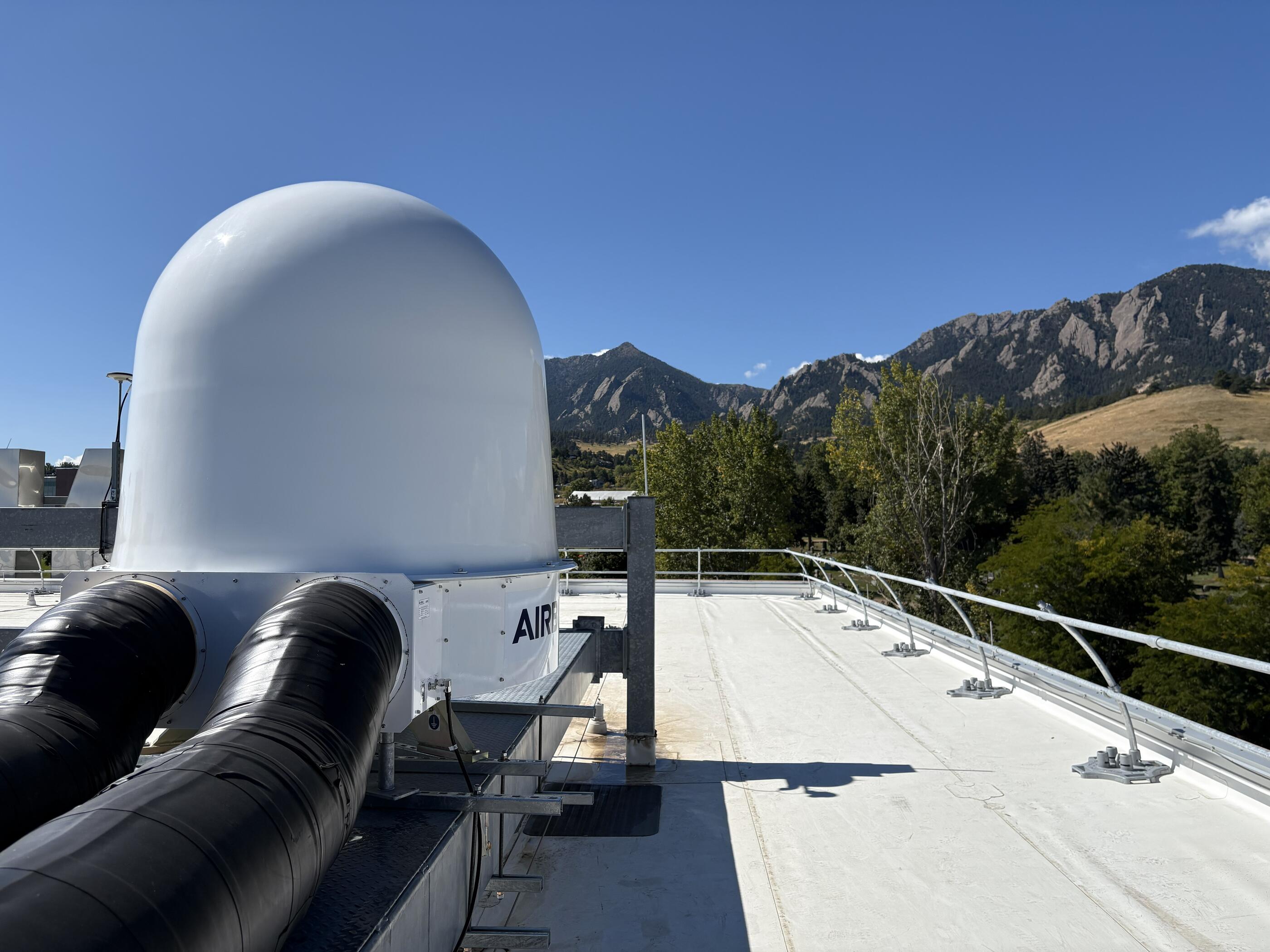
Image details
Source-supplied image. No retouching or generative changes by The Daybreak. Teasers may crop for layout.
A better second must remain the same second
The advance in optical clocks also creates a standards question. The BIPM’s roadmap FAQ says the best optical frequency standards have surpassed the best realizations of the current cesium-based definition. It describes options based on either one optical transition or an ensemble of transitions. Its timetable gives 2030 as the earliest ratification date for a new definition, following consideration of a proposal. That is a roadmap, not an announcement that the second has already changed.[8]
Continuity is one of the stated requirements. Existing cesium standards would not abruptly become useless; the framework envisages their continued role as secondary standards. The problem is to make a more precise realization available and comparable, while preserving the unit that existing measurements already use. The FAQ also identifies transfer links as a limiting part of distributing optical-clock performance.[8]
A new definition would therefore be a change in how the unit is anchored and realized, not a decision to make the day noticeably longer or shorter. This is the quiet infrastructure of measurement: an improvement has to be reproducible by other laboratories and usable by people who never see the record-setting apparatus. A standard succeeds through agreement and dissemination as well as precision.
An old relationship, turned around
John Harrison faced an earlier version of the problem of carrying reliable time beyond a controlled setting. The Royal Museums Greenwich account follows his marine timekeepers through development and trials in the effort to determine longitude. The aim was to preserve a reference time at sea, where a useful instrument had to perform through motion and changing conditions. Its value depended on more than an impressive result on a workbench.[3]
The modern story turns part of that relationship around. Instead of taking time along to help determine position, scientists can compare the passage of time to investigate the conditions at different positions. The route from laboratory to field still demands careful engineering. What has changed is the extraordinary sensitivity of the reference and the physical questions it can now expose.
That is what makes the clock such an unusual scientific instrument. It measures something familiar enough to organize a morning, yet precise enough to reveal that different places do not share exactly the same rhythm. Once the apparatus, the comparison and the uncertainty are understood, time becomes another way to examine the world.
Sources & further reading
Original reporting and research behind this article.
- NIST: relativity measured across a millimeter-scale atom sampleFeb 16, 2022
- NIST: Relativity and Optical ClocksSep 24, 2010
- Royal Museums Greenwich: Harrison’s timekeepersUndated reference; consulted September 12, 2026
- NIST: improvements to the aluminum-ion clockJul 14, 2025
- Caldwell, Triano and Sinclair: optical time and frequency transferMay 2, 2025
- Grotti and colleagues: geodesy with a transportable optical clockMay 11, 2017
- NIST: mountain and space clock experimentsFeb 25, 2026
- BIPM: questions about redefining the secondMar 21, 2025