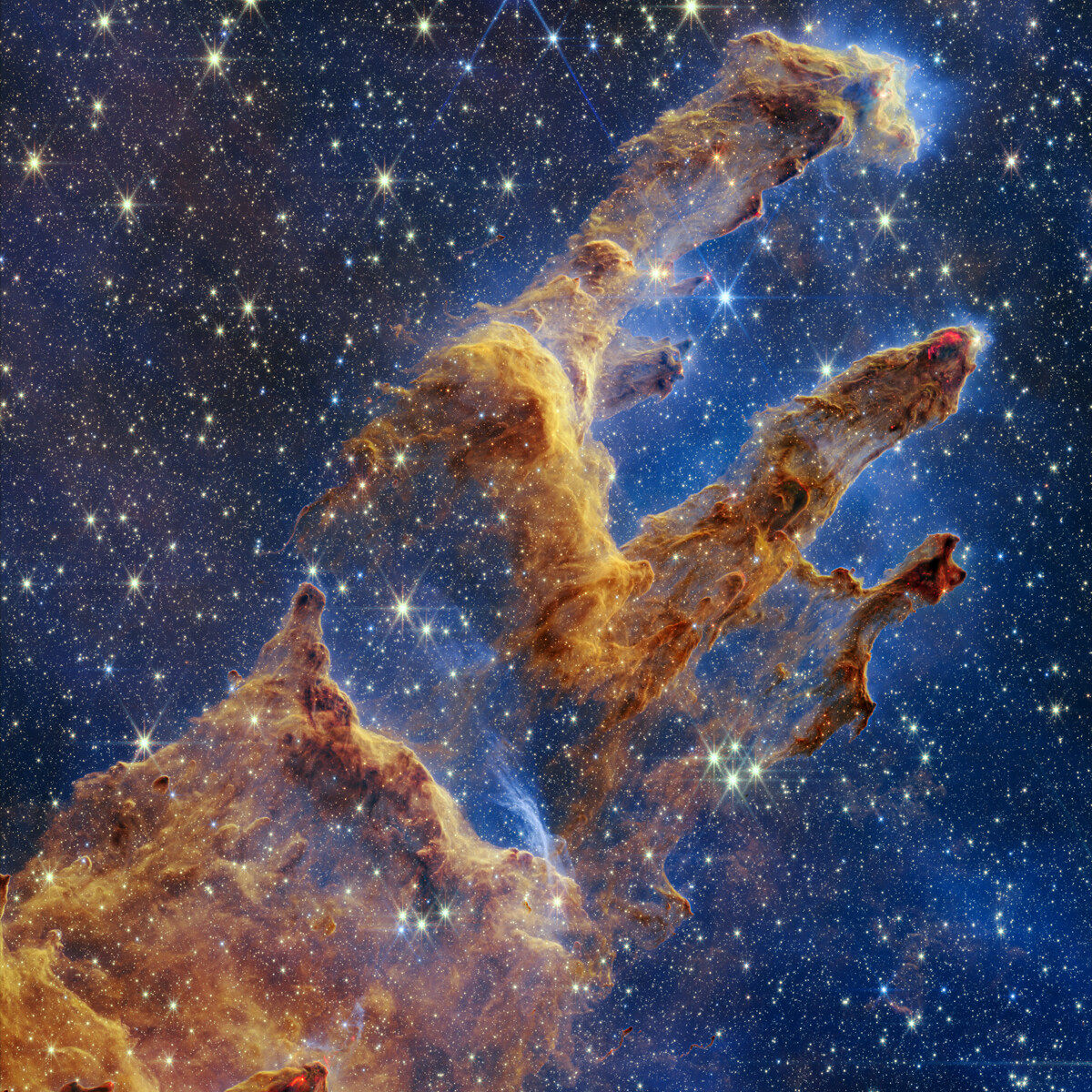
In Webb’s 2022 near-infrared observation of the Pillars of Creation, the red details are part of the science. Some bright objects are young protostars; wavy structures along the columns record outflows interacting with surrounding gas and dust. The image captures a stellar nursery being altered by the stars forming within it.[1]
The apparent depth can be misleading. ESA’s explanation notes that the interstellar medium still obscures the more distant universe: the lack of background galaxies does not mean the telescope simply ran out of sensitivity. What becomes visible depends on the material along the line of sight as well as the instrument’s wavelength coverage.[1]
Researchers use observations like these to constrain the number and distribution of young stars and the material available around them. Comparing instruments is valuable because each selects a different physical view. A spectacular image is not a neutral window; it is a measurement shaped by filters, sensitivity and processing.[1]
That is also why the colors should be understood as a translation of infrared measurements into visible form. The image is based on actual telescope observations, rather than a generated illustration. Its scientific value lies in the relationship between those measured signals and the structures they reveal.
Sources & further reading
Original reporting and research behind this article.