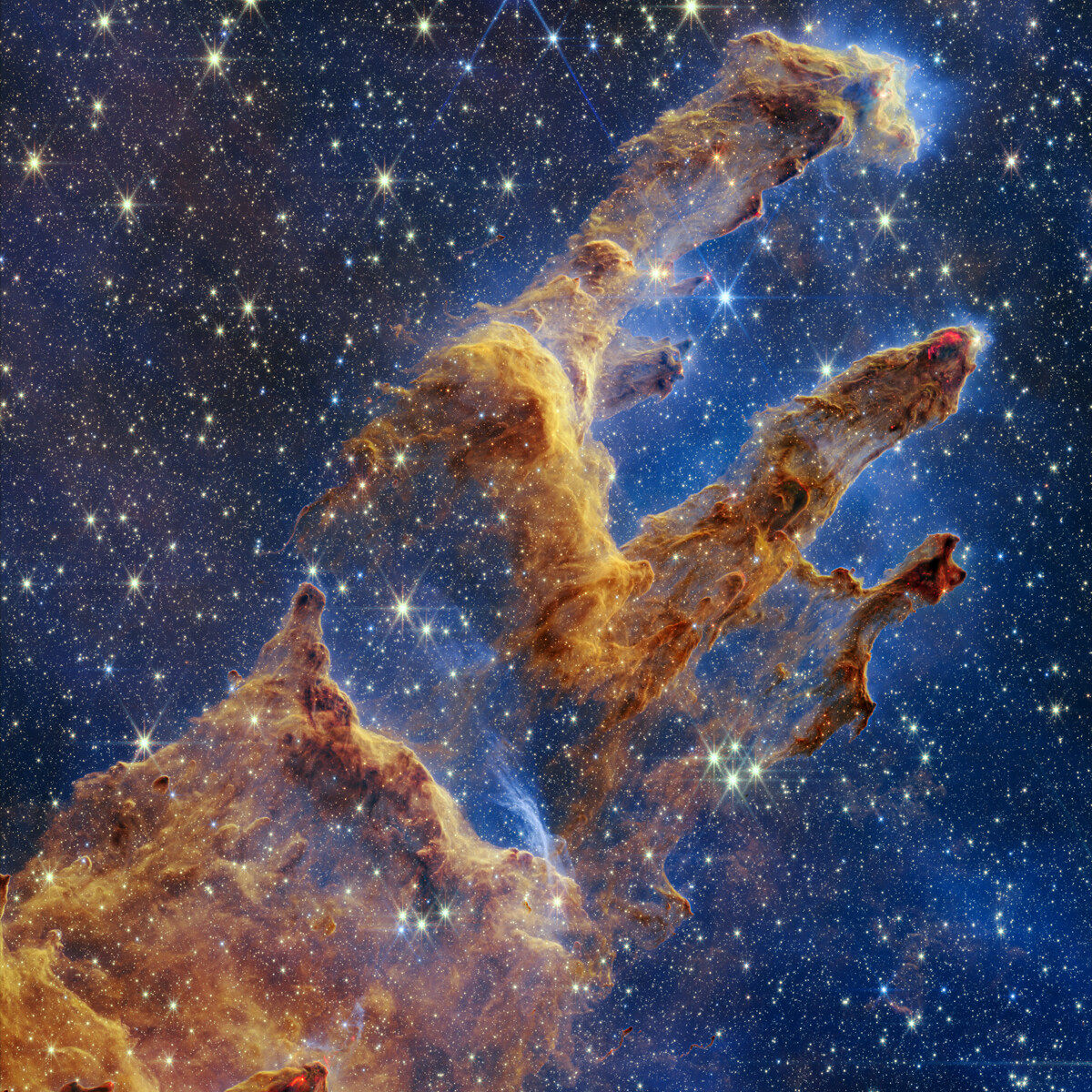
In Webb’s 2022 near-infrared observation of the Pillars of Creation, the red details are part of the science. Some bright objects are young protostars; wavy structures along the columns record outflows interacting with surrounding gas and dust. The image captures a stellar nursery being altered by the stars forming within it.[1]
The apparent depth can be misleading. ESA’s explanation notes that the interstellar medium still obscures the more distant universe: the lack of background galaxies does not mean the telescope simply ran out of sensitivity. What becomes visible depends on the material along the line of sight as well as the instrument’s wavelength coverage.[1]
The productive way to look at the picture is to ask what would disappear if the instrument changed. Stars that dominate one view may recede in another. Material that looks like an obstruction can become the subject of the measurement. The apparent landscape is assembled from signals that respond differently to temperature, composition and the wavelength being observed.
The same place, a different measurement
Webb’s Mid-Infrared Instrument supplied that comparison in an image released nine days later. Much of NIRCam’s crowded stellar field falls away. The blue-gray pillars and their dusty edges take over the frame. ESA’s account explains that many stars are less prominent at these wavelengths, while dusty young objects can still stand out. The disappearance is largely a change in what the instrument detects, rather than evidence that the region suddenly lost its stars.[2]
The Pillars lie in the Eagle Nebula, about 6,500 light-years away. In the mid-infrared view, dark gray marks dense dust, while diffuse material makes a reddish region above the columns. The observations help researchers investigate the amount and character of that dust. This makes the second image scientifically complementary to the first: a stellar census and a map of the surrounding material are related tasks, but they are not interchangeable.[2]
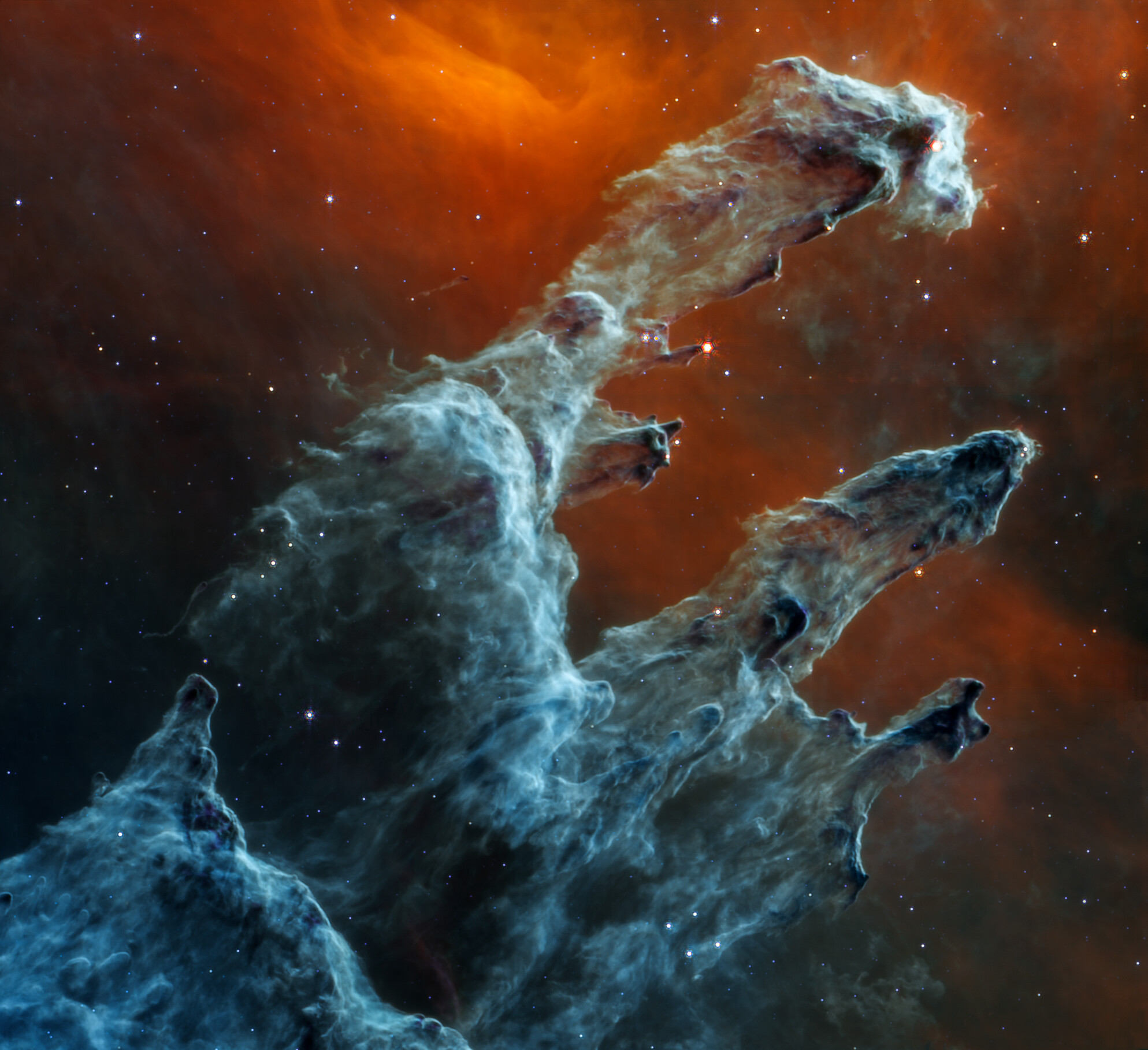
Image details
Source-supplied image. No retouching or generative changes by The Daybreak. Teasers may crop for layout.
A useful visual comparison starts with the outline of the tallest pillar. Follow the same edge through both images before comparing individual points of light. The structure gives an anchor; the stars and dust show how the measurement changes around it. Looking only for the more dramatic color palette misses the information supplied by their disagreement.
Color is a translation with a purpose
Webb sends measurements through separate filters, recording brightness rather than an ordinary color photograph. Image processors combine and align frames, remove instrumental artifacts, and assign visible colors to the resulting channels. Some images also combine multiple pointings into a mosaic. The finished picture translates measurements beyond human vision into a form that can be inspected on a screen.[3]
This does not make every visual interpretation equally valid. A color assignment must be read alongside the filter information and processing explanation. It can help separate structures that would be difficult to distinguish in a single monochrome exposure. It cannot turn a particular shade into a universal temperature scale, or make an infrared scene identical to what an astronaut would see by eye.[3]
Consider the difference between a map and a window. A map can convey information that a window cannot, provided its symbols are understood. These images offer something similar: a deliberately constructed view whose choices can make physical relationships easier to see. Their beauty does not disqualify them as evidence. It makes the explanation of their construction more valuable.
Neither picture is a time-lapse account of a star’s birth. They are observations of a region containing objects at different stages, interpreted with models and other measurements. Reading them well means resisting the temptation to turn every striking shape into a complete story. The pair is more revealing than either frame alone because each makes the limits of the other visible.
Sources & further reading
Original reporting and research behind this article.
- ESA/Webb: Pillars of Creation observation and interpretationOct 19, 2022
- ESA/Webb: the Pillars in mid-infrared lightOct 28, 2022
- ESA/Webb: how telescope images are processedUndated reference; consulted September 12, 2026